

Michelle Jokisch Polo
Stateside ProducerMichelle Jokisch Polo is a producer for Stateside. She joins us from WKAR in Lansing, where she reported in both English and Spanish on a range of topics, including politics, healthcare access and criminal justice. Her stories have appeared on NPR, as well as WBUR's Here & Now and Marketplace. Michelle began her career as a journalist as the head reporter at El Vocero Hispano, the largest Hispanic newspaper in Michigan.
-
 Michigan school vaccine exemptions have reached the highest level in more than two decades. Experts explain what’s driving the increase. Plus, find the vaccination rate for your local school district.
 -
 As teenagers look for a job this summer, they are facing an everchanging labor market and economic uncertainty.
 -
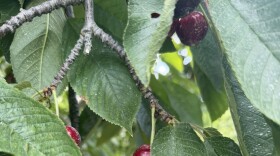 A listener shares his story about the lessons a forgotten cherry tree gave him.
 -
 Come July, cherries are everywhere here: sweet, sour, deep maroon, golden yellow, and even blush pink. Michigan is the second-largest producer of cherries in the nation. But why?
 -
 In 1994, a Michigan stadium made history by becoming the first indoor venue to host the World Cup games.
 -
 In Michigan, immigrants being held inside detention centers often have no idea of when their cases will be resolved. Dozens have been held for over six months and for some it's been closer to a year. Mental health experts say the uncertainty coupled with the prolonged isolation can take a psychological toll, with the effects often growing more severe the longer a person is detained.
 -
![PLACEHOLDER: An editorial collage set against a muted gray-purple background, combining three layered elements. On the left, a torn envelope or piece of mail bearing the logo and address of the GEO Group's North Lake Processing Center. In the center, a heavily distorted, glitched portrait of a person whose face is obscured through digital fragmentation, suggesting anonymity and erasure. On the right, a partially visible medical report form with several fields heavily redacted in black. Visible handwritten entries include an incident date of 3-16-2026, a time of 09, a checked "Yes" box next to "necessary to notify physician?", "N/A" written next to a "Fighting" checkbox, and a handwritten description reading "Sexual assault from housin[g]" occurring at "3-4am."](https://npr.brightspotcdn.com/dims4/default/9b8d60f/2147483647/strip/true/crop/1920x1070+0+5/resize/280x156!/quality/90/?url=http%3A%2F%2Fnpr-brightspot.s3.amazonaws.com%2F9f%2F3d%2F1547e7294b60b5ff7f4823f3a84d%2Fq-story-headers-wip-10.png) Una ex detenida asegura que sufrió agresiones sexuales reiteradas en North Lake Processing Center y que sus intentos de reportarlas a los administradores del centro no recibieron respuesta inicial.
Una ex detenida asegura que sufrió agresiones sexuales reiteradas en North Lake Processing Center y que sus intentos de reportarlas a los administradores del centro no recibieron respuesta inicial. -
A former detainee says she was repeatedly sexually assaulted at the North Lake Processing Center and that her attempts to alert administrators initially went unheeded.
-
![An editorial collage combining a black-and-white photograph of the Patrick V. McNamara Federal Building, home to the Detroit Immigration Court, with colorful torn-paper fragments of text clipped from immigration court bond hearing documents. The scraps — in pink, blue, and green — display partial phrases including "Granted" (with a checked checkbox), "Denied" (with a checked checkbox), "a flight risk," "Respondent is a flight risk," "the Immigration Judge denied Pe[titioner]," "(ICE), released Petit[ioner]," "under bond of $5,000," "bond of $15,000, with," and "Denied, because." The overlapping fragments visually contrast bond grants and denials, evoking the bureaucratic and high-stakes nature of immigration detention proceedings.](https://npr.brightspotcdn.com/dims4/default/0595959/2147483647/strip/true/crop/1920x1070+0+5/resize/280x156!/quality/90/?url=http%3A%2F%2Fnpr-brightspot.s3.amazonaws.com%2F75%2F7b%2Fa875b7d043b4b67d5862f5501af5%2Fbond-headers-5.png) Los inmigrantes detenidos en Michigan demandaron al gobierno federal para intentar obtener su libertad. Las demandas funcionaron para cientos de personas, pero un nuevo análisis muestra que eso está cambiando.
Los inmigrantes detenidos en Michigan demandaron al gobierno federal para intentar obtener su libertad. Las demandas funcionaron para cientos de personas, pero un nuevo análisis muestra que eso está cambiando. -
 From the 1700s to today, the way we play euchre has evolved in so many ways. Today, we’re sharing stories from two listeners who have taken that tradition and made the game their own.


![PLACEHOLDER: An editorial collage set against a muted gray-purple background, combining three layered elements. On the left, a torn envelope or piece of mail bearing the logo and address of the GEO Group's North Lake Processing Center. In the center, a heavily distorted, glitched portrait of a person whose face is obscured through digital fragmentation, suggesting anonymity and erasure. On the right, a partially visible medical report form with several fields heavily redacted in black. Visible handwritten entries include an incident date of 3-16-2026, a time of 09, a checked "Yes" box next to "necessary to notify physician?", "N/A" written next to a "Fighting" checkbox, and a handwritten description reading "Sexual assault from housin[g]" occurring at "3-4am."](https://npr.brightspotcdn.com/dims4/default/750b7f9/2147483647/strip/true/crop/1920x1070+0+5/resize/560x312!/format/webp/quality/90/?url=http%3A%2F%2Fnpr-brightspot.s3.amazonaws.com%2F9f%2F3d%2F1547e7294b60b5ff7f4823f3a84d%2Fq-story-headers-wip-10.png)
![An editorial collage combining a black-and-white photograph of the Patrick V. McNamara Federal Building, home to the Detroit Immigration Court, with colorful torn-paper fragments of text clipped from immigration court bond hearing documents. The scraps — in pink, blue, and green — display partial phrases including "Granted" (with a checked checkbox), "Denied" (with a checked checkbox), "a flight risk," "Respondent is a flight risk," "the Immigration Judge denied Pe[titioner]," "(ICE), released Petit[ioner]," "under bond of $5,000," "bond of $15,000, with," and "Denied, because." The overlapping fragments visually contrast bond grants and denials, evoking the bureaucratic and high-stakes nature of immigration detention proceedings.](https://npr.brightspotcdn.com/dims4/default/c57a8e5/2147483647/strip/true/crop/1920x1070+0+5/resize/560x312!/format/webp/quality/90/?url=http%3A%2F%2Fnpr-brightspot.s3.amazonaws.com%2F75%2F7b%2Fa875b7d043b4b67d5862f5501af5%2Fbond-headers-5.png)
